Beyond the Fan Account: The Unexpected Friendships Forming Inside Maria's Community
Fan communities have been around as long as there have been people worth admiring. But the traditional model has always been pretty one-directional: fans look up, toward the person they follow. The connection flows from creator to audience, and the audience mostly exists in parallel — lots of individuals having their own private relationship with the same public figure.
What's been happening inside Maria's community breaks that model in ways that are genuinely surprising — and genuinely moving.
The Lateral Turn
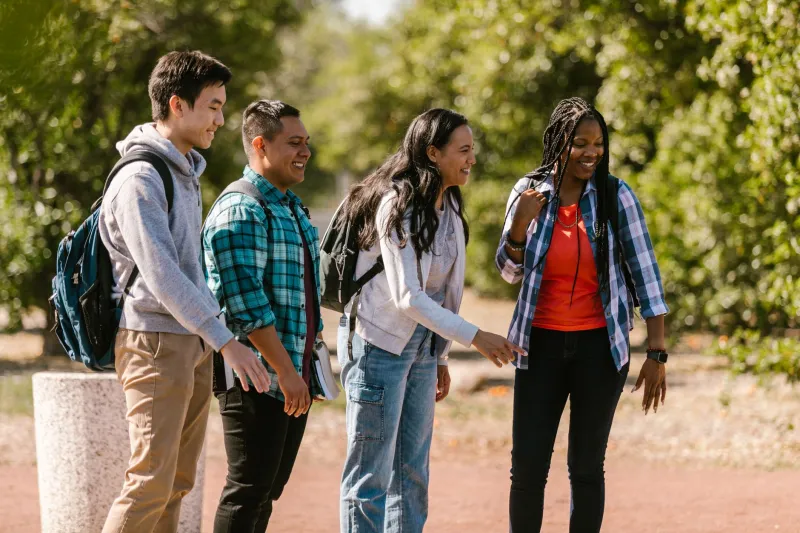
Call it the lateral turn. Instead of a community where everyone is oriented toward Maria and only Maria, what's developed over time is something more like a web. Fans connect with each other. They recognize each other across platforms. They collaborate. They show up for one another during hard weeks. Some of them have become actual, real-world friends.
This doesn't happen by accident, and it doesn't happen in most fan spaces. It happens here because of something specific about how Maria engages with her community — and what she models about connection in general.
"She talks a lot about the people around her," observes one community member from Seattle who goes by the handle @clarityandchaos online. "Not in a name-dropping way, but in a way that makes it obvious she values her relationships deeply. I think that filters down. People in her community tend to actually care about each other, because she's shown us that caring about people is the whole point."
What the Community Actually Looks Like
Spend some time in the spaces where Maria's fans gather and a few things become clear pretty quickly. The conversation isn't mostly about Maria. It's about life. People share what they're working on, what they're struggling with, what they're excited about. Maria comes up, sure — she's the reason everyone's in the same room — but she's more like a shared reference point than the constant subject.
Fan accounts dedicated to her work frequently double as creative showcases for the fans themselves. Someone who started documenting Maria's aesthetic eventually started sharing their own photography. Someone who came to talk about her music ended up finding a writing partner for their novel. Someone who was drawn in by her candid conversations about anxiety found a group of people who check in on each other every week.
"I honestly don't think I would have kept making art if I hadn't found this community," says Dani, a 24-year-old illustrator from Austin. "People here actually look at what you make. They give real feedback. They celebrate when something goes well. It started because we all liked Maria, but it's become something that would keep going even if she disappeared tomorrow."
Why This Model Is Different
Most creator communities are built around aspiration and proximity — the feeling of being close to someone you admire. That's not nothing; parasocial connection is a real and meaningful thing. But it's also inherently asymmetrical, and asymmetrical relationships have a ceiling.
What Maria has cultivated — whether consciously or as a natural extension of who she is — is something more symmetrical. Fans don't just feel seen by her. They feel seen by each other. And that's a fundamentally different kind of belonging.
Community researchers who study online spaces have noted that the most resilient digital communities are the ones where members develop what's called "horizontal ties" — connections to peers rather than just to the central figure. These ties make the community durable in a way that purely creator-dependent spaces aren't. If the creator goes quiet, the community doesn't collapse. It has its own internal gravity.
Maria's community has that gravity. You can feel it.
The Peer Support Ecosystem
One of the more remarkable things that's emerged is an informal but remarkably functional support network. Mental health comes up a lot in Maria's work — she's been candid about her own experiences in ways that clearly opened a door for her audience. What walked through that door wasn't just empathy for her, but permission for fans to be honest with each other.
Comment threads that start as responses to Maria's content regularly evolve into genuine check-ins. Discord servers and group chats that formed around her work have become places where people talk about therapy, medication, grief, career anxiety, and relationship struggles — not just the creator's latest project.
"There's a corner of the internet that feels genuinely kind, and it's mostly people who found each other through Maria," says Marcus, a 29-year-old from Philadelphia. "I've had harder conversations in those spaces than I have with some people I've known for years in real life."
The Collaborative Projects
Beyond emotional support, the community has also become a genuinely creative space. Collaborative zines, shared playlists, group art projects, writing challenges — things that started as fan activities have taken on lives of their own.
One ongoing project involves community members creating illustrated responses to themes Maria has explored in her work. It's evolved into a quarterly digital publication that features dozens of contributors, most of whom met through Maria's comment sections or fan forums. Maria herself has acknowledged the project publicly, but it runs entirely on community energy.
"That's the thing about what she's built," says one of the project's organizers. "She didn't build a fan club. She built a community that knows how to take care of itself."
What This Means Going Forward
As the creator economy continues to evolve, the communities that will last are the ones that don't depend entirely on the creator to keep them alive. Maria's community looks like one of those. It's warm, self-sustaining, and oriented toward something bigger than any single person's platform.
For fans, that's not a small thing. In a media landscape that often leaves people feeling more isolated the more they consume, finding a community that actually pulls people together — laterally, peer to peer, human to human — is genuinely rare.
Maria didn't set out to build a movement. She set out to connect honestly with people. But honest connection, it turns out, is contagious.